



Trade, capital, and people flows adapt to a shifting world
Amidst a constantly changing global geopolitical landscape, the forces expected to make countries more cautious in their trade relationships have instead pushed countries to become more strategic in how they manage them. Trade tensions between the U.S. and China, geopolitical conflicts, and a rising tide of tariffs all seemingly point to a world that is becoming less connected—but the data tells a different story.
According to the latest DHL Global Connectedness Report 2026, global flows of trade, capital, and people show only modest year-on-year shifts. The data—collected before the February 2026 U.S. attack on Iran—presents a strong case for the remarkable resilience of cross-border connections.
Globalization evolving, not retreating
Despite geopolitical tensions and economic uncertainty, goods trade patterns changed less in 2025 than during other recent disruptions. These included the 2008 global financial crisis and the early stages of the Russia-Ukraine conflict.
Global flows of goods in 2025 were boosted by the front-loading of U.S. imports ahead of tariff changes in April, with March 2025 U.S. imports 26 percent above the 2024 average. The redirection of Chinese exports toward alternative markets as firms adapted to shifting trade policies also affected the data, with China’s export volumes between March 2025 and November 2025 standing 7-15 percent above 2024 levels.
At the same time, a rising demand in AI-related products saw trade in AI-related infrastructure generating 42 percent of goods trade growth in the first three quarters of 2025, accounting for 15 percent of overall goods trade, according to the World Trade Organization.
Did the U.S. announcement of a sharp tariff increase in April 2025, and the Trump administration’s subsequent adjustments, affect trade volumes? The data shows that direct trade between the U.S. and China fell from a peak of 3.6 percent of global trade in 2015 to 2 percent in the first nine months of 2025.
The bigger picture, however, provides a clearer global perspective. It is worth bearing in mind that at 2 percent, trade between the world’s two largest economies as a portion of global flows is relatively small. 98 percent of global trade endures elsewhere as the U.S. and China decouple, driving resilience and growth. Instead of contracting, the volume of global goods trade is projected to grow an average of 2.6 percent annually between 2026 and 2029, the same as the actual growth rate in the past decade.
Going the distance
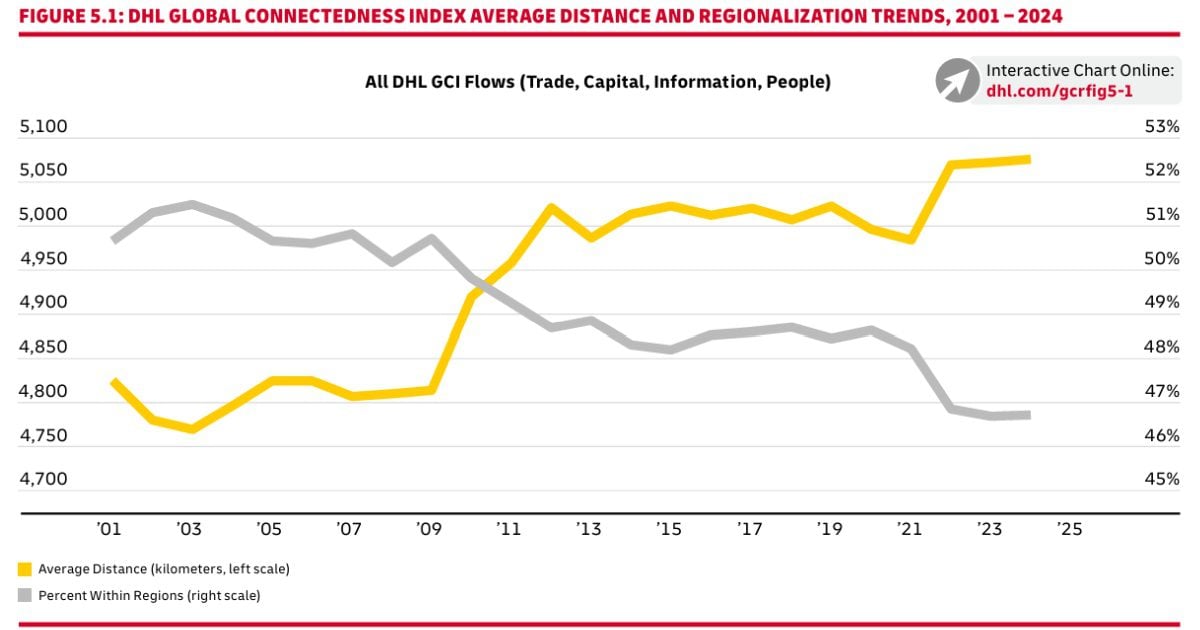
The DHL Global Connectedness Report 2026 notes that there is no sign that supply chains are becoming more concentrated within geographic regions. In 2025, traded goods traveled the longest average distance—5,010 kilometers—on record, the opposite of what would be expected if globalization were retreating.
Global supply networks are steadfastly international. In 2025, about 21 percent of the value of all goods and services produced worldwide crossed at least one border, slightly below the 22 percent peak in 2008. A strongly connected global market means more choice and convenience for consumers around the world.
Despite a dominant narrative that businesses would favor relations with suppliers that were geographically nearer or more politically aligned with them, geopolitical shocks had less impact on global integration than many observers expected. The average distance traveled by the four pillars of the DHL Global Connectedness Index—trade, capital, information, and people—increased to the longest recorded at 5,080km. Meanwhile, the percentage of activity within regions hovered near the historic low, at 46.8 percent.
Because of the search for alternative markets, bilateral trade negotiations, particularly those involving Asia Pacific nations, have accelerated. India finalized a free trade agreement with the European Union in January 2026, promising to remove tariffs on more than 95 percent of goods. Smaller economies within Asia Pacific are seeking deals just as actively. In 2025-26, markets in the region made up nearly 60 percent of preferential trade agreements in force worldwide.

Southeast Asian countries outperform in globalization
Singapore takes the lead within the region and has once again topped the ranking in the DHL Global Connectedness Report as the world’s most globalized country, with 11 other Asia Pacific nations among the top 60. The other countries in the top five were, in ranking order, Luxembourg, the Netherlands, Ireland, and Switzerland.
“Asia Pacific continues to demonstrate extraordinary resilience and adaptability,” said Ken Lee, CEO of DHL Express Asia Pacific. “The DHL Global Connectedness Report shows that countries across our region—from Singapore to Malaysia, Thailand, Vietnam and beyond—are deepening their global ties and attracting new trade flows.”
The three highest-ranked middle-income countries in the report are Malaysia, Thailand and Vietnam, with Lao PDR and Malaysia respectively achieving the world’s 3rd and 7th largest increases in global connectedness since 2019. Indonesia, Philippines, and Vietnam, together with India, were the four countries highlighted as ranking in the top 30 for speed and scale of forecast trade growth over 2025-29 in the DHL Trade Atlas 2025.
Through ASEAN, Southeast Asian countries are deepening regional integration and participating in two key trade agreements—the Comprehensive and Progressive Agreement for Trans-Pacific Partnership (CPTPP) and the Regional Comprehensive Economic Partnership (RCEP).
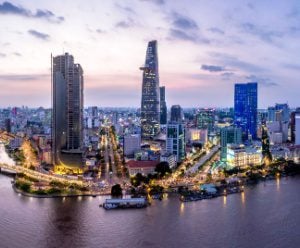
Vietnam stands out as a case study in globalization supporting economic development. Since its economic reforms in 1986, Vietnam’s GDP per capita has surged from roughly US$420 to US$4,700 in 2024, as its goods exports as a share of GDP soared from 9 percent to 87 percent. By this measure, Vietnam has become the world’s sixth most export-oriented economy.
Inward FDI has also supported Vietnam’s growth, with multinational firms bringing capital, technology, and market expertise. The country is forecast to achieve the world’s fourth largest absolute increase in goods trade over 2026–30, behind only China, India and the U.S.
Shifting opportunities for trade and talent
The recalibration of supply chains is also affecting how capital, skills, and knowledge move across borders.
Foreign direct investment (FDI) continues to play a key role in this shift, as firms establish facilities and logistics hubs closer to emerging markets or alternative sourcing regions. The percentage of announced greenfield FDI projects between unaligned blocs has increased sharply since 2021 and is forecast to have exceeded the share within the US bloc in 2025. The average distance for greenfield FDI projects also rose to a new high of 6,250km.
People are moving as well. International travel, student mobility, and migration have all rebounded strongly since the pandemic, surpassing pre-2020 levels in many cases. These flows help move skills and expertise into the regions where new manufacturing and service hubs are emerging. Global economic links are reinforced as knowledge and skills spread across borders.

Globalization’s next phase
It is true that geopolitical events disrupted global flows of goods in 2025, but the world remains very far from a split into disconnected geopolitical blocs. The DHL Global Connectedness Report 2026, prepared with the NYU Stern School of Business, finds no clear indication of widespread “deglobalization”. Instead, international connections across trade, capital, information and people remain strong.
What is changing is the structure of globalization.
Businesses today have more options than ever for organizing production, sourcing materials, accessing talent, and reaching customers. They can relocate manufacturing facilities, develop new logistics routes, or tap into emerging markets.
For policymakers and corporate leaders alike, the message is clear: globalization is not disappearing. Rather, it is becoming more complex and more strategic.
Companies and countries will need to adapt continuously as global systems evolve. “Even as global patterns shift, Asia remains a central engine of global trade. This is why we continue to invest in and enhance our Asia Pacific network, particularly in the eight fast-growing markets that DHL Group has identified,” said Lee. “Our priority is to support businesses to stay connected and diversify their markets.”
The businesses that succeed will be the ones that recognize a simple truth highlighted by the report: the benefits of international connectedness are too significant to ignore.

ALSO WORTH READING






 English