



Supply chain resilience is the new currency for ocean freight

Key takeaways
- Trade remains resilient despite disruption.
- Supply chain resilience is becoming more important than freight rates alone.
- The return to the Suez route may improve efficiency but not certainty.
For much of 2026, many expected disruption to eventually slow trade.
Typhoons have battered major Asian ports. The Panama Canal continues to face water-level constraints. Carriers are cautiously returning to the Suez Canal amid ongoing geopolitical uncertainty. Oil prices remain elevated, while port congestion in Asia has climbed to near-pandemic levels.
Instead, global ocean freight demand continues to grow.
“Peak season has proven stronger than anticipated,” said Niki Frank, CEO, DHL Global Forwarding Asia Pacific. “Export demand remains resilient, and global trade flows continue to move despite geopolitical tensions, weather disruptions and elevated transportation costs.”
That resilience extends beyond container shipping. The latest DHL Globalization Tracker found that global goods trade grew faster in the first half of 2026 than in any other half-year during the previous 15 years, excluding the exceptional post-pandemic rebound.
The latest ocean freight data shows a market that continues to defy expectations. Global ocean demand is up five percent year to date, driven largely by Asian exports, which have grown nine percent year to date despite ongoing disruption.
The freight market increasingly reflects a broader reality: companies continue to trade internationally despite rising complexity and uncertainty.
Congestion puts reliability back in the spotlight
While cargo continues to move, moving it predictably is becoming increasingly difficult.
Across major trade lanes, congestion is rising, schedules are becoming less reliable and carriers continue adjusting routes in response to changing operating conditions. As a result, many shippers are no longer asking whether cargo can be shipped, but whether it can arrive when expected.
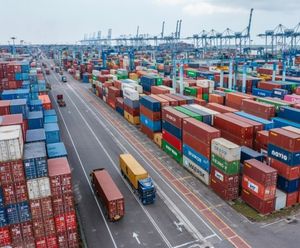
Global port congestion has climbed to about 3.8 million TEU, approaching levels not seen since the height of earlier supply-chain disruptions. Severe weather events, particularly typhoons affecting major Chinese ports, have played a key role in creating vessel backlogs and schedule disruption.
The effects extend well beyond the ports themselves.
Delays at one location can ripple across vessel rotations, equipment positioning and inland transport networks. What begins as a localized disruption can quickly become a challenge that affects cargo movements across multiple regions.
The most significant consequence of disruption may not be delays alone. It is uncertainty.
Schedule reliability has fallen to its lowest level since 2022, with less than one-third of vessels arriving on time in some key gateways. While cargo is still moving, arrival times have become increasingly difficult to predict.
“Today, many businesses are placing greater value on supply chain resilience instead of rates because delays can create costs elsewhere in the supply chain,” said Bjoern Schoon, Senior Vice President, Ocean Freight, DHL Global Forwarding Asia Pacific.
The cautious return of the Suez Canal
The gradual return of services to the Suez Canal has led more shippers to take the shorter route to relieve some backlog pressure. As of October, 37 percent of relevant Asia-Europe headhaul services and 50 percent of backhaul services were again planned to transit via Suez.
The shift could shorten transit times, improve equipment utilization, and help carriers restore efficiency to networks that have spent much of the past two years adjusting to disruption.
Yet a shorter route does not necessarily mean a simpler supply chain.
Carriers continue to balance the efficiency gains of Suez against geopolitical risk, insurance requirements and operational uncertainty. Routing decisions remain subject to security assessments, meaning schedules and network configurations may need to adapt as conditions evolve.
For shippers, this creates a new layer of planning complexity. The return of Suez may reduce transit times, but it also places greater emphasis on understanding routing options, insurance coverage and contingency plans should conditions change.
Supply chain resilience becomes the new competitive advantage
Fuel costs remain a major concern, with Very Low Sulfur Fuel Oil (VLSFO) bunker prices 58 percent above pre-war levels. With the Strait of Hormuz remaining effectively constrained, geopolitical uncertainty continues to support elevated transportation costs.
Despite all this, trade continues to expand. The DHL Globalization Tracker found that the overall effects of tariffs and recent geopolitical shocks have been more limited than many expected. Global trade has continued to grow despite the disruption.
The ocean freight market is proving that strong demand alone is not enough to guarantee smooth supply-chain performance.
“For many shippers, the competitive advantage may no longer come from finding the lowest freight rate,” noted Frank. “It may come from building supply chains resilient enough to operate in a market where uncertainty has become the norm.”
MORE FROM THIS COLLECTION



 English