



Ocean and air freight on diverging paths in 2026

In 2025, ocean and air freight markets face shared challenges - geopolitical instability, unpredictable demand, and evolving trade rules. However, the two modes enter 2026 with contrasting supply-demand balances that are expected to influence freight costs in the year ahead.
“2026 is expected to be a year of very different realities for shippers depending on mode, geography and routing,” said Niki Frank, CEO of DHL Global Forwarding Asia Pacific. “Shippers that embrace agility—operational and environmental—will weather the storm and emerge stronger in a market defined by resilience and responsibility.”
SUEZ CANAL BACK IN THE SPOTLIGHT
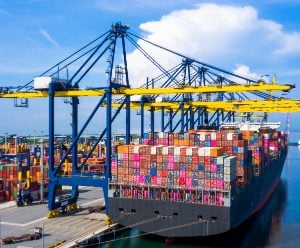
For ocean shippers, all eyes are back on the Suez Canal, which may soon welcome more container vessels now that the Houthi threat appears to have vastly diminished. As a start, CMA CGM and several regional operators are running limited and primarily backhaul services through the Red Sea and Suez Canal into the Mediterranean.
However, resuming services through the Suez Canal represents more than a routing change. It could have a significance on a market that has been supported by transits around southern Africa. Along with port congestion, diversions have swallowed around 10-15 percent of effective global container shipping capacity in 2025.
Industry consensus suggests that widespread adoption of the Suez route is likely to occur only after the Chinese New Year, subject to the safety of seafarers, vessels, and cargo. The required reshuffling will take anywhere from three to six months, with severe congestion expected in already overstretched European ports.
The year ahead tells a different story, with nominal fleet capacity forecasted to grow by four percent in 2026, down from seven percent in 2025. However, effective capacity—reduced by congestion and detours—is expected to rise faster as movement along the Suez Canal resumes. Carriers hold orderbooks equivalent to 30–50 percent of their current fleets, ensuring a steady influx of new tonnage through 2028.
At a period when carriers have been receiving record numbers of new ships from yards, this matters to bottom lines, because spot freight rates have been in decline on most east-west trades since summer. After the initial disruption and volatility settle, market analysts suggest prices could soften further, with some analysts predicting a rate war among shipping lines as they push to fill vessels amid excess capacity taking its toll. Other analysts, however, have pointed out that low oil prices are making the diversion around Africa more cost effective for carriers compared to costly Suez Canal transit fees.
Ultimately, the price impact will depend on how successful carriers are in allocating spare capacity. Stability will require operational reshuffling and congestion management for carriers to get their ducks in a row.
“A full-scale return of liner services to the Red Sea would initially be disruptive, with increased risks of port congestion, landside capacity constraints, and short-term cost implications,” said Bjoern Schoon, Senior Vice President, Ocean Freight, DHL Global Forwarding Asia Pacific. “However, once networks stabilize, it will benefit shippers through faster transit times, and the trade is likely to become more competitive on pricing.”
The timing of this shift remains uncertain. Although some operators are reportedly close to resuming Canal transits, others continue to weigh the security and insurance implications. Shippers negotiating long-term contracts are balancing how much capacity to commit when potential disruptions and freight rate declines could be imminent. Locking service and reliability requirements into contracts will no doubt be a key priority for many freight buyers.
AIR CARGO ON DIFFERENT FLIGHT PATH
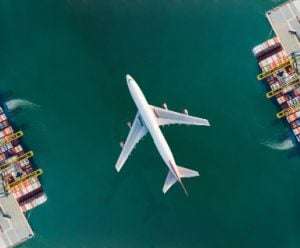
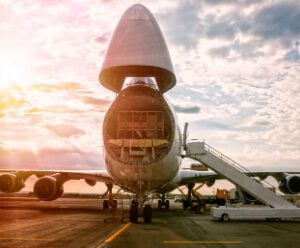
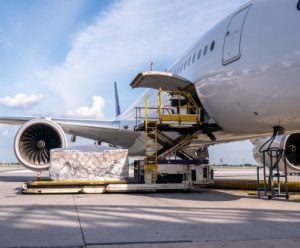
The expected ocean market recalibration will ripple through air cargo in complex ways. Beyond the potential decline of sea-air hybrid solutions, air freight could see a temporary spike in demand as shippers with critical cargo avoid port congestion delays that accompany the Suez Canal return.
Global air cargo demand has remained resilient, finishing 2025 with three to five percent growth and entering 2026 with demand outpacing structurally constrained capacity in several lanes.
However, the market fundamentals of air freight differ significantly from those of ocean freight. While carriers are struggling with an excess supply of ships, air cargo capacity had a softer increase at approximately two percent year-on-year in December 2025. Passenger belly-hold now accounts for 66 percent of total capacity, while dedicated freighter capacity is down seven percent year-on-year. The limited freighter availability has thus established a market floor for rates.
Asia’s air freight takes flight amid U.S. uncertainty
Even with a broader year-on-year decline of around three percent in global spot rates in November (~$2.66/kg), Asia-origin lanes firmed late in the season: Asia-to-Europe rates rose for eight consecutive weeks to $4.70/kg, and China-to-Europe reached $5.21/kg, marking a high for the year 2025. Mainland China-Europe rates increased eight percent year-on-year in Week 50, while Hong Kong-Europe and Korea-Europe were lower year-on-year.
While U.S. demand has stalled, Asia’s exporters have re-routed to Europe or newer, more developing markets. Regional demand leadership shifted toward Asia Pacific (+11 percent), with Middle East and Africa (+7 percent), and Europe (+3 percent) also expanding. North America posted a slight -0.4 percent contraction—its first in nearly a year. High-tech flows have been pivotal for December 2025, as AI component exports expanded around 20 percent year-on-year, and South Korea’s semiconductor surge (close to 42 percent) amplified trans-Pacific and Asia-Europe uplift.
In the year ahead, Asia’s demand growth is forecasted to grow approximately 2.6 percent, with the corresponding capacity growing steadily, alongside passenger belly network growth.

Navigating the emissions challenge in Europe
While operational dynamics dominate headlines, sustainability regulations are quietly transforming cost structures. The EU ETS is now fully operational for maritime transport, covering 100 percent of emissions for voyages in and out of Europe since January 2026. In this final phase of a gradual rollout that began in 2024, ETS charges have risen by another 35 to 50 percent, bringing them to their final 100 percent coverage. Carriers, in essence, will procure emission allowances and pass these costs to shippers, adding a significant surcharge to European trades. For high-volume lanes, this could translate into additional costs per shipment, depending on trade lane and volume.
The potential cost increases from the carbon emissions reduction policies make low-emission transport options increasingly attractive. Forwarders like DHL Global Forwarding now offer sustainable marine fuel (SMF) solutions under its GoGreen Plus service that can abate emissions and waive surcharges. These options not only reduce carbon footprints but also provide cost predictability through emission reduction certificates. In time, such alternatives will shift from niche to mainstream, especially for shippers with stringent ESG targets.
Starting the year strong with advanced planning
In 2026, both ocean and air freight must navigate a myriad of challenges. Beyond the potential re-opening of the Suez Canal and a cost-efficient approach to emission-reduction policies, businesses must also consider geopolitical headwinds from potential U.S. tariff changes, which affect ongoing tensions in global trade relationships.
While container lines seek solutions to excess supply, air cargo should remain relatively stable, due to its ability to adapt quickly to shifting global trade patterns.
“In ocean freight, greater capacity is expected to shift negotiating power toward shippers. In air freight, market indicators suggest a more stable environment, with seasonal and event-driven fluctuations,” noted Frank.
ALSO WORTH READING






 English