



Asia Pacific powers global ocean and air market amid volatility

At a time when the world could do with a bit of good news, Asia Pacific is quietly delivering one: trade is still moving, growing, and, against the odds, finding its rhythm.
Even as headlines tilt toward disruption, the region’s freight markets continue to show resilience, with solid demand on the ocean side and steady, tech‑driven momentum in air cargo. Global ocean demand grew a robust 4 percent in 2025, led overwhelmingly by exports out of Asia, while air cargo demand rose 8 percent year‑on‑year in January 2026, with Asia Pacific alone accounting for around half of global volume growth.
“Asia remains the world’s most reliable engine of trade — and that, at least, is something worth smiling about,” said Niki Frank, CEO, DHL Global Forwarding Asia Pacific.
According to DHL’s Global Connectedness Report 2026 – which measures the globalization of about 180 countries and territories – Singapore is the world’s most globally connected country, while the three highest-ranked middle-income countries on the DHL Global Connectedness Index are all in Southeast Asia: Malaysia, Thailand, and Vietnam.
These promising demand indicators, however, coexist with geopolitical shocks. The uncertain situation at the Strait of Hormuz, ongoing Suez Canal diversions, and widespread Middle East airspace restrictions are reshaping networks, grounding or rerouting thousands of flights. This has led to constrained usable air cargo capacity, creating ripple effects seen in every major Asia‑origin trade lane.
On top of the geopolitical shocks, the annual Lunar New Year disruptions, severe Northern Hemisphere winter weather, and shifting tariff environments have created an environment defined not by peaks and troughs, but by persistent unpredictability.
Nominal capacity growth amid constraints
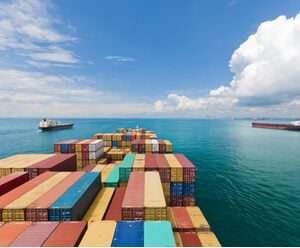
Ocean carriers entered 2026 with a paradox: fleets are expanding, but effective capacity is shrinking. While nominal global container capacity is up three percent year‑on‑year, effective capacity is reduced by around 16 percent due to congestion and continued Cape of Good Hope diversions.
Asia‑linked disruptions are central. The Strait of Hormuz closure has removed 1.4 percent of the global container fleet from circulation, trapping vessels inside the Persian Gulf. Port congestion worldwide is tying up more than three million TEU at any given time, with most regions (excluding the Americas) approaching or exceeding their 2022 pandemic‑era congestion levels. Equipment tightness continues at several Asian load ports, a by‑product of erratic schedules, longer rotations and blanked sailings.
On the global level, air freight capacity grew about five percent year‑on‑year in February 2026, with passenger bellyhold recovery driving strong gains, especially across Europe.
While the aggregate global numbers show growth, it is not evenly distributed across regions. Flight bans and diversions across Iran, Iraq, the UAE, Qatar and Israel due to airspace restrictions have created global knock‑on effects, tightening capacity precisely where transit connectivity is critical. Airlines are shifting aircraft away from lanes exposed to policy and geopolitical risks, generating pockets of tightness.
Asia at the helm of demand growth
Asia’s export strength continues to define the global ocean market. Demand remained solid throughout 2025, with particularly strong year‑over‑year gains on lanes from Asia to Europe, MENAT, Latin America, Africa and Oceania.
Volumes saw a relatively quick bounce back as factories resume production and shippers accelerate exports ahead of China’s VAT rebate changes.
The evolving U.S. tariff rules continue to create uncertainty in recent months. While the Supreme Court ruled that the IEEPA tariffs were unconstitutional, thus revoking a wide range of tariffs, a new tariff, valid for 150 days, was announced to be in effect.
“Tariffs, however, simply shift global trade instead of stopping it,” said Bjoern Schoon, Senior Vice President, Ocean Freight, DHL Global Forwarding Asia Pacific. Overall, 2025 closed with 4 percent market demand growth vs. 2024, with Asian exports responsible for the majority of that expansion.
High‑tech and e‑commerce sectors take flight
Air cargo demand is structurally firm. The 8 percent year‑on‑year increase in January 2026, with Asia Pacific growing 12 percent year-on-year and contributing roughly 50 percent of global volume growth, underlines the region’s central role in airfreight.
The seasonal Lunar New Year did put a damper on the regional month-on-month numbers. The mid‑February period saw around a 20 percent decline in volume from China and Southeast Asia as factories closed. Demand fundamentals, however, remained strong as high‑value components for data centers and AI‑related hardware continue to move steadily, supporting Asia–Europe lanes.
E‑commerce flows, while seeing the first year‑on‑year drop from China since January 2022, still represent a substantial share of Asia‑origin air volumes.
IATA forecasts global air cargo demand growth of around 3 percent for 2026, with Asia Pacific leading the upswing even as growth remains uneven across other regions.
“Asia’s maturation as a diversified production ecosystem is clearly visible: when one vertical softens, another accelerates,” said Fabio Weiss, Senior Vice President, Air Freight, DHL Global Forwarding Asia Pacific.
Rates being pulled in different directions
Ocean freight rates across Asia‑origin lanes remain significantly elevated compared to pre‑crisis benchmarks. According to the Shanghai Containerized Freight Index (SCFI), Asia–Europe spot rates continue to sit firmly above their Q3 lows, even after a post‑LNY correction, though they are a bit lower year‑on‑year before the recent war outbreak.
The SCFI forecasts rates to be significantly volatile in the weeks to come. For one, freight rates on Asia-Europe lanes remain elevated despite recent decline, induced by Chinese manufacturers looking for new demand. In addition, war‑risk surcharges and emergency fees are rising across worldwide trades, adding a layer of unpredictability to base rates that were already volatile.
Air freight rates tell different stories depending on the region, and the divergence is striking. Severe winter disruptions, strikes, tighter environmental policies and associated cost pressures have led to a 12 percent increase for exports. Strong tech and e‑commerce volumes, plus weather‑related and geopolitical capacity constraints, have contributed to a seven percent increase for exports originating from Asia Pacific.
In short, the rate floor is rising in many places, even as some corridors see relief from earlier spikes.
Prolonged disruption, patchy relief
Volatility is the only certainty in the months ahead. On top of the recent situation in the Middle East, a return to the Suez Canal is off the table for now.
That implies ongoing route detours, keeping transit times extended on Asia–Europe and related swings. Port congestion in Asian transshipment hubs will likely add to the complexity as the Middle East disruption has started to impact worldwide trades.
Demand is expected to stay firm on nearly all Asia outbound trades, with North America as the notable question mark due to evolving U.S. trade policy and slower import growth. However, persistent equipment imbalances for ocean freight in Asia, especially in key export hubs where empty container repositioning struggles to keep pace, will add to the pressure on the supply and demand balance.
Air freight is forecast to see a controlled rebound in Q2 rather than a sharp spike, with Asia–Europe and intra‑Asia routes leading the recovery from the post‑LNY slump. However, lane‑specific tightness where airspace restrictions and weather volatility intersect will keep businesses on their toes.
Nonetheless, Asia’s role as the world’s main growth driver is set to continue, underpinned by high‑value manufacturing, electronics and cross‑border e‑commerce.
The common thread that ties to both modes lies with agility. “In a landscape where neither mode offers complete predictability, integrated planning across ocean and air has become an essential resilience tool for Asia‑based supply chains,” noted Frank.
ALSO WORTH READING





 English