



Fueling the narrative of a tight freight market
In 2026, freight markets are not being shaped by a single shock, but by a chain reaction. Fuel prices jump, rates respond immediately, networks re‑route, and only then does demand and capacity find a new—often unstable—balance.
For shippers in Asia, the story is less about whether goods will move, and more about how much friction and cost is now built into every move.
“Success in this environment depends less on finding the cheapest rate and more on building buffer into schedules, budgets, and routing strategies across both ocean and air freight,” said Niki Frank, CEO, DHL Global Forwarding Asia Pacific.
Fuel has become the primary price setter
Across both ocean and air freight, rates are no longer reacting primarily to cargo volumes. Instead, fuel volatility is now the dominant driver, with surcharges acting as the fastest transmission mechanism from energy markets to shipper invoices.
Bunker fuel is resetting the floor for ocean freight over the past few weeks. While carriers entered 2026 with relatively disciplined capacity and steady Asian export demand, that balance shifted rapidly as energy prices spiked.
DHL’s Ocean Freight Market Update for April shows VLSFO bunker fuel prices rose 71 percent month on month, an increase described as “unheard of in the last decade and beyond”.
Fuel represents 20–25 percent of ocean carriers’ operating costs, meaning such a spike translates directly into higher freight rates. In response, carriers across trade lanes introduced Emergency Bunker Surcharges, layered on top of existing BAF mechanisms.
As a result, container rates moved quickly. The Shanghai Containerized Freight Index rose 35 percent year on year, and futures suggest further upward pressure through Q2 as surcharges are fully implemented and routing distances remain extended.
For Asian shippers, the impact is felt earlier than in other regions due to geographic proximity and shorter lead times in the oil supply chain, while Europe tends to experience the lagged effect weeks later.
Taking to the skies, jet fuel prices are also showing the immediacy of the impact on rates. DHL’s latest Airfreight State of the Industry noted that between late February and March 2026, Brent crude surged 56 percent to around US$111 per barrel, while jet fuel prices jumped 64 percent to roughly US$170 per barrel.
Airlines responded almost instantly. Fuel surcharges increased across regions, and spot rates accelerated. By Week 12, global air cargo rates rose 7 percent week on week to US$2.84 per kilo, while spot rates reached US$3.38 per kilo, up 26 percent year on year. Asia Pacific rates alone were 18 percent higher YoY, despite demand volatility.
Asia continues to move goods amid rising costs
Despite higher rates, demand has not softened. Instead, it has re‑sequenced itself geographically, with Asia remaining as the primary source of growth in both ocean and air freight.
“Asia is still powering global trade as freight continues to move along. The question is whether it will move on the schedule and cost assumptions that were made last quarter,” said Fabio Weiss, Senior Vice President, Air Freight, DHL Global Forwarding Asia Pacific.
On top of that, tariffs and geopolitics are redirecting trade instead of grounding it to a halt. Asian exports continue to find demand, even when destination markets change.
Global container demand grew 3 percent year on year in 2026, with Asian exports responsible for the majority of that increase. Key Asia‑linked trade lanes posted strong gains early in the year: Asia–Europe volumes rose 22 percent YoY, Asia–Africa 15 percent, and Asia–Oceania 20 percent.
Air cargo data tells a similar story. In February 2026, global air cargo demand grew 7 percent YoY, while Asia led with 14 percent YoY growth.
The Asia–Europe air corridor, which represents 22 percent of global air cargo volumes, grew 8 percent YoY February 2026 as Asian demand proved resilient, supported by technology, electronics, and time‑critical manufacturing supply chains.
In short, demand is flexing, not fading. The constraint lies elsewhere.
Plenty of capacity on paper, scarce in practice
“The market is no longer just limited to supply and demand. It is demand, plus detours, plus fuel, plus network friction,” said Bjoern Schoon, Senior Vice President, Ocean Freight, DHL Global Forwarding Asia Pacific.
The DHL Ocean Freight Market Update describes a direct impact of the developing situation in the Middle East on shipping patterns: Persian Gulf ports are not being called, and cargo is being discharged into alternate congested ports (including Jeddah, Salalah/Sohar, and Khor Fakkan), followed by costly overland re-routing.
It also flags that 100+ vessels are stuck in the Persian Gulf, representing about 400,000 TEU, or slightly more than 1 percent of global capacity—a small percentage that can still cause an outsized ripple when networks are tightly scheduled.
The indirect impact is where Asia feels it most: congestion increases at transshipment ports, including Sri Lanka and Singapore, while bunker fuel availability is reduced in typical bunker ports such as Singapore, with refueling delays of 10+ days.
On paper, ocean container shipping looks almost calm. Global ocean capacity is expected to grow about 3 percent year over year in 2026, and demand is also projected to grow around 3 percent.
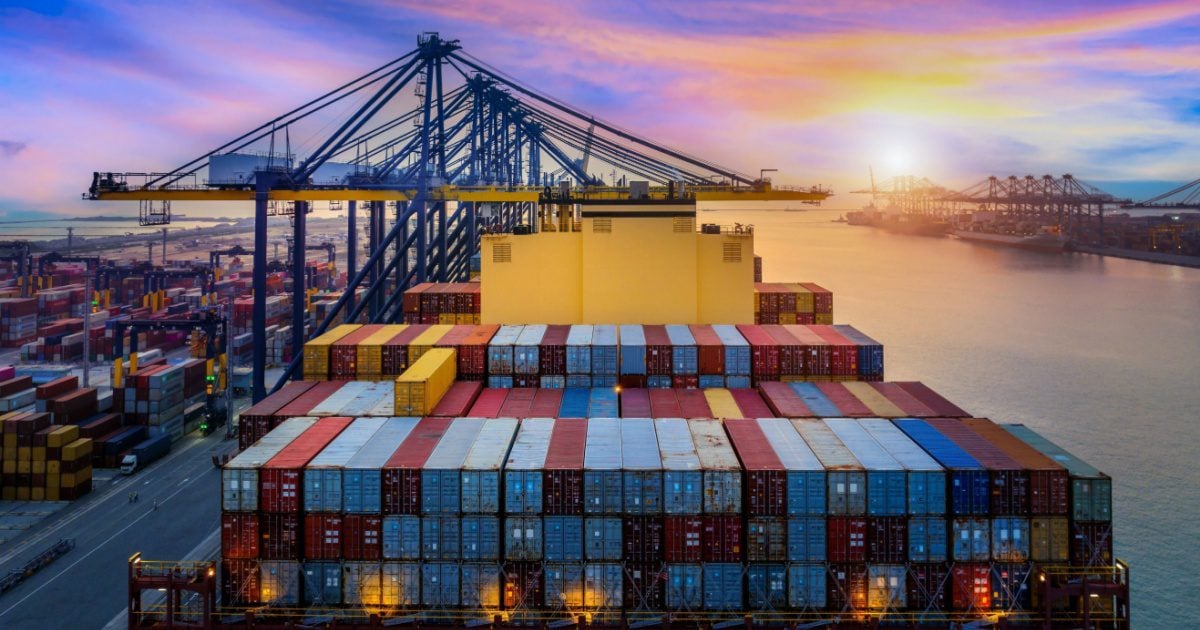
“Nominal” capacity is growing, but “effective” capacity is still constrained. DHL’s Ocean Freight Market Update quantifies the gap: nominal capacity is reduced by ~17 percent, largely due to congestion and detours. In practical terms, the report highlights container equipment scarcity, as less empty containers returning from the Gulf to Asian origins. This has kickstarted an equipment imbalance in Asia.
The result is familiar to shippers: ships exist, slots exist, yet space feels tight as bookings compete with a network that is physically larger, but operationally slower.
Disrupted hubs are also tightening the air freight network. Global air cargo tracking capacity fell 7 percent YoY (MTD March 2026), with the Gulf—the world’s largest air cargo hub region—recording a 64 percent drop.
Asia‑Europe capacity has since increased, but largely as replacement capacity routed around the Middle East, not genuine expansion. These longer routings come with higher fuel burn, lower network efficiency, and persistent 7–10 day backlogs in major transit hubs.
In air freight, the capacity story is sharper than ocean freight, except it is costlier and harder to access predictably.
Accepting and softening the risks
Shippers cannot eliminate today’s freight risks, but they can redistribute and soften them. “The most resilient shippers are those who shift from rate‑led decisions to option‑led strategies,” noted Frank. “That means choosing logistics partners that offer more routing options, more carrier choices, clearer surcharge rules, and tighter alignment between logistics planning and inventory strategy.”
Asia remains at the center of global freight flows—but moving goods now requires accepting higher costs, longer routes, and fewer certainties. Shippers who acknowledge this shift early, and design flexibility into their logistics strategies, will be better positioned to ride the volatility rather than react to it.
ALSO WORTH READING




 English